
TECHNOLOGY · COMPRESSED AIR · VEHICLE FINISHING · OEM SPECIFICATION
Why Pakistan’s automotive paint shops should rethink oil contamination at the source — especially as new assembly lines, EV programmes and export-quality requirements raise the bar for surface finish.
In a car paint shop, a single drop of oil carried in the compressed air can turn into a visible defect on a finished body panel — a crater, a fisheye, a patch that simply refuses to hold its coating. On a line running hundreds of panels a shift, that one drop is not a small problem. It is rework, scrap, and a warranty claim that can surface long after the vehicle has left the plant — with your name on the door.
Paint is the one process where compressed air touches the product directly. It atomizes the coating, moves the part through the booth, and drives the tools around it. Everywhere else in the plant, air does its work behind the scenes. In the paint shop, it becomes part of the surface the customer sees, touches, and judges.
The filter chain — and where it fails
The conventional answer is a filtration chain: an oil-lubricated compressor generates the air, and a series of filters, separators, and dryers downstream pull that air back within specification before it reaches the booth. It works — as long as every filter is maintained on schedule, every element is replaced before it saturates, and nothing slips past during a pressure spike or a hot, humid afternoon.
That is a lot of conditions to hold true, every shift, for years. Each filter is a consumable and a maintenance dependency. Each is also a single point of failure standing between an oil-lubricated machine and a wet paint surface — and every point of failure eventually becomes someone’s Monday-morning problem.
Oil-free by design, not by filtration
There is a simpler way to frame the problem. If there is no oil inside the compressor at all, oil is not something you filter out downstream. It was never introduced in the first place.

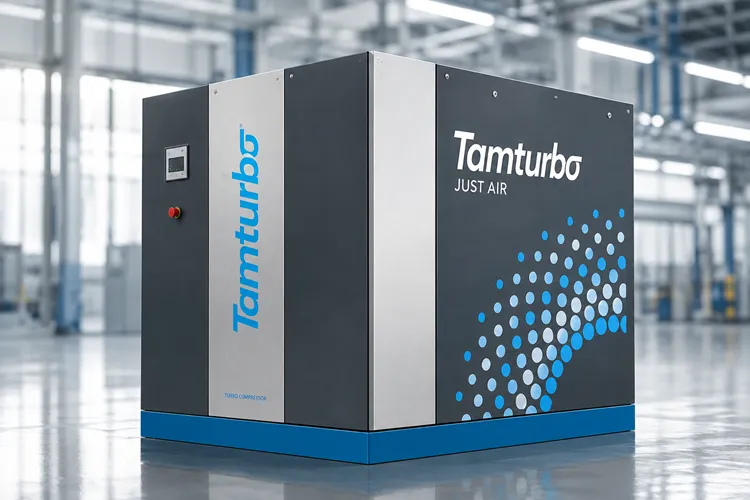
That is the principle behind Tamturbo® Touch-Free™ technology. The compressor’s shaft runs on active magnetic bearings — it floats on a controlled magnetic field, with no oil in the bearings, gears, or seals, because there is nothing there that needs lubricating. The result is air that is 100% oil-free, certified to ISO 8573-1 Class 0 — the highest purity class in the standard — achieved by design rather than by filtration.
“If there is no oil inside the compressor, oil is not something you filter out later. It was never introduced.”
For a paint line, where a single contaminated batch can cost far more than any filter element, that distinction is worth a serious look at your next system review — or your next capex cycle. The question worth asking on your own site is simple: what does an hour of paint-line rework actually cost you?
What it means at commissioning
- Fewer consumables to manage — no oil-removal filter chain to schedule, stock, and replace before it saturates.
- Certified purity, on paper — ISO 8573-1 Class 0 is the standard your export customers and global OEM partners audit against.
- One less point of failure — specify it once at design stage and it stays right, rather than inheriting a filter chain you maintain for the next two decades.
Why this matters more in the EV era
This is not a new concern — but it is a sharper one now. Pakistan’s automotive sector is in the middle of the most significant shift in its history. Under the National Electric Vehicle (NEV) Policy 2025–2030, the government has set a target of 30% of new vehicle sales being electric by 2030, rising to around 90% by 2040. BYD, through its local partner Mega Motor Company, is building an assembly plant near Karachi expected to come online in the second half of 2026; Sazgar, MG, and others are extending into hybrids and EVs; and dozens of two- and three-wheeler makers have already secured local-assembly certificates.
For EV manufacturers, finish quality is not a detail — it is part of the brand promise. EV buyers are, on average, paying a premium and expecting a premium product: deep, even, flawless paint with no visible defects. An EV’s clean, minimalist body language leaves nowhere for a fisheye or an orange-peel patch to hide. The very customers most drawn to a “clean” technology are the least forgiving of a visibly imperfect surface.
There is a second reason the EV moment matters. Many of these plants are greenfield or newly expanded lines. When you are specifying a paint shop’s utilities from scratch, you can build in oil-free-by-design air from day one — rather than inheriting an oil-lubricated system and a filter chain you will maintain for the next two decades. Getting the compressed-air architecture right at the design stage is far cheaper than correcting it after commissioning.
Beyond finish — energy, emissions, and the export ambition
Clean air by design also aligns with where the whole industry is being pushed. The NEV policy is, at its core, an energy and emissions play — the government projects it could displace billions of litres of imported fuel and cut millions of tonnes of CO₂ each year. Compressed air is one of the largest single consumers of electricity in any manufacturing plant, and an efficient, oil-free system supports the same sustainability goals the sector is now being measured against.
For parts manufacturers with export ambitions, the calculus is even more direct. Oil-free, Class 0 air is often a prerequisite for supplying global OEM programmes and for meeting the surface-quality and cleanliness standards that international buyers audit against. Clean air is not just about avoiding a defect at home — it is about qualifying for the customer abroad.
The engineering question for Pakistan’s automotive paint shops
For Pakistan’s vehicle assemblers and component manufacturers, the issue is less about choosing one compressor technology and more about defining the air-quality risk the paint process can tolerate. Established OEMs, new EV entrants and Tier suppliers all face the same basic question: should oil contamination be controlled downstream through filtration, or eliminated at the source through an oil-free compressor architecture? As paint-quality expectations rise, that question deserves a place in utility design reviews alongside pressure, flow, dew point, energy efficiency and redundancy.
Oil-free technology available in Pakistan
One technology option now available to Pakistani manufacturers is Tamturbo® Touch-Free™ oil-free compressed air, represented locally by Rastgar & Co. Its active magnetic-bearing design removes the need for lubricating oil in the compressor’s bearings, gears or seals and is designed to deliver ISO 8573-1 Class 0 air. For paint-shop engineers, the relevance is straightforward: oil purity is addressed at the compressor architecture level rather than relying solely on downstream oil-removal filtration.
The right solution will still depend on each plant’s demand profile, existing compressor room, air-treatment system, paint-process requirements and lifecycle economics. Before a retrofit or new paint-shop investment, manufacturers should measure actual air quality, flow, pressure, dew point and energy performance, then compare the technical and financial case for conventional filtration against oil-free-by-design alternatives. Rastgar can support that assessment, system sizing, installation, commissioning and local aftermarket service where Tamturbo is selected.
| A Practical Next StepBefore specifying or expanding a paint line, verify what is actually reaching the booth. A compressed-air assessment can establish air quality, pressure, flow, dew point, energy performance and contamination risk — providing an engineering baseline before any equipment decision is made.Technical enquiries: Rastgar & Co. | Call / WhatsApp: +92 334 5933391 | www.rastgar-co.com |